How to Choose the Best Software House in Lahore for Your Project (2026 Guide)
If you search for the “best software house in Lahore,” you will see dozens of identical agencies claiming they are “global leaders” with “award-winning teams.” But when you sign the contract, who is actually writing your code? Is it a vetted team of senior engineers, or a couple of underpaid juniors while the agency pockets your margins? With over half of all software projects failing to meet their original specs or timelines, you don’t need a list of agencies — you need a vetting system that filters out the noise.
That number isn’t an exaggeration. The Standish Group’s CHAOS Report — the most-cited long-running study on IT project outcomes — has consistently found that fewer than 3 in 10 software projects fully meet their original time, budget, and quality targets; the rest ship late, run over budget, arrive with cut features, or get scrapped outright. We’ve sat across the table from founders who came to us after exactly that happened. This isn’t a “top 10 software houses in Lahore” listicle — it’s the actual checklist we’d hand a friend before they sign a contract: what to ask, what to ignore, what a fair price looks like, and where most engagements quietly go wrong. By the end, you’ll know exactly how to shortlist a software house in Lahore with the same rigor an experienced buyer would use.
Why Lahore Has Become Pakistan’s Software Outsourcing Hub
Lahore isn’t the accidental tech hub people sometimes assume it is. It’s home to some of Pakistan’s oldest and largest engineering universities — UET, LUMS, and Punjab University all feed a steady graduate pipeline into local dev shops — which is part of why Lahore, alongside Karachi and Islamabad, anchors most of the country’s software company in Pakistan landscape.
In our experience, three things make Lahore specifically attractive to overseas clients:
- Cost-to-quality ratio. Development rates typically run well below US/UK/EU/Gulf market rates for comparable skill levels, without the quality drop-off that used to be a real risk a decade ago.
- English fluency as a default, not a differentiator — this matters more than people expect once a project moves past the kickoff call and into daily Slack/email back-and-forth.
- Time zone overlap with the Gulf and partial overlap with Europe, which makes Lahore-based teams easier to sync with in real time than some other outsourcing hubs.
None of that means every software house in Lahore is equally good — the city has both genuinely strong engineering teams and a large number of shops that are essentially a WhatsApp number and a Fiverr profile. The rest of this guide is about telling them apart.
What “Software House” Actually Means — And What It Doesn’t
This sounds basic, but it trips people up constantly. “Software house” gets used loosely to describe everything from a two-person freelance duo to a 200-person outsourcing firm with dedicated QA and DevOps departments. Before you evaluate anyone, decide which of these you’re actually looking for:
A true software house typically offers:
- Structured project management (not just a developer replying to messages when they’re free)
- Dedicated QA/testing separate from the developer who wrote the code
- A design function (UI/UX Design) that isn’t an afterthought bolted onto development
- Post-launch support as a defined service, not a favor
What it’s often confused with:
- A freelance collective operating under a shared brand name with no real internal process
- A reseller/broker that quotes you a price, then subcontracts the actual build to a cheaper third party you never meet
- A single-founder shop where “the team” is one person wearing five hats
None of these are automatically bad — a skilled freelancer can outperform a disorganized agency. But you need to know which one you’re hiring, because it changes what questions matter. If you’re evaluating a software house in Lahore specifically because you want redundancy (so the project doesn’t die if one person gets sick or leaves), a single-founder shop defeats the purpose regardless of how talented that one person is.
Red Flags We See Before Clients Sign a Bad Contract
We’ve reviewed enough failed engagements — clients who came to us mid-project, asking for a rescue — to recognize the same handful of warning signs repeating.

1. A quote that arrives within minutes of sharing requirements.
Serious estimation takes at least a short discovery conversation. A same-day, fixed-price quote on a moderately complex app usually means either the vendor isn’t reading your requirements closely, or they’re planning to pad scope disputes later to make up the difference.
2. No named project manager or point of contact.
If every communication funnels through “the team” with no single accountable person, expect confusion the moment something goes wrong. In our experience, this is the single biggest predictor of scope creep turning into a dispute.
3. Portfolio links that don’t actually work, or that show only static screenshots.
A software company in Pakistan claiming e-commerce or SaaS expertise should be able to show you a live product, not just a Behance-style mockup gallery. Click the links before the sales call.
4. Reluctance to put milestones and payment terms in writing.
This is non-negotiable. Verbal assurances about timelines mean nothing once a deposit has cleared.
5. Pressure to pay 100% upfront.
Some deposit is normal — 30–50% is common for smaller fixed-scope projects. A demand for full payment before any work starts is a legitimate reason to walk away, regardless of how good the pitch was.
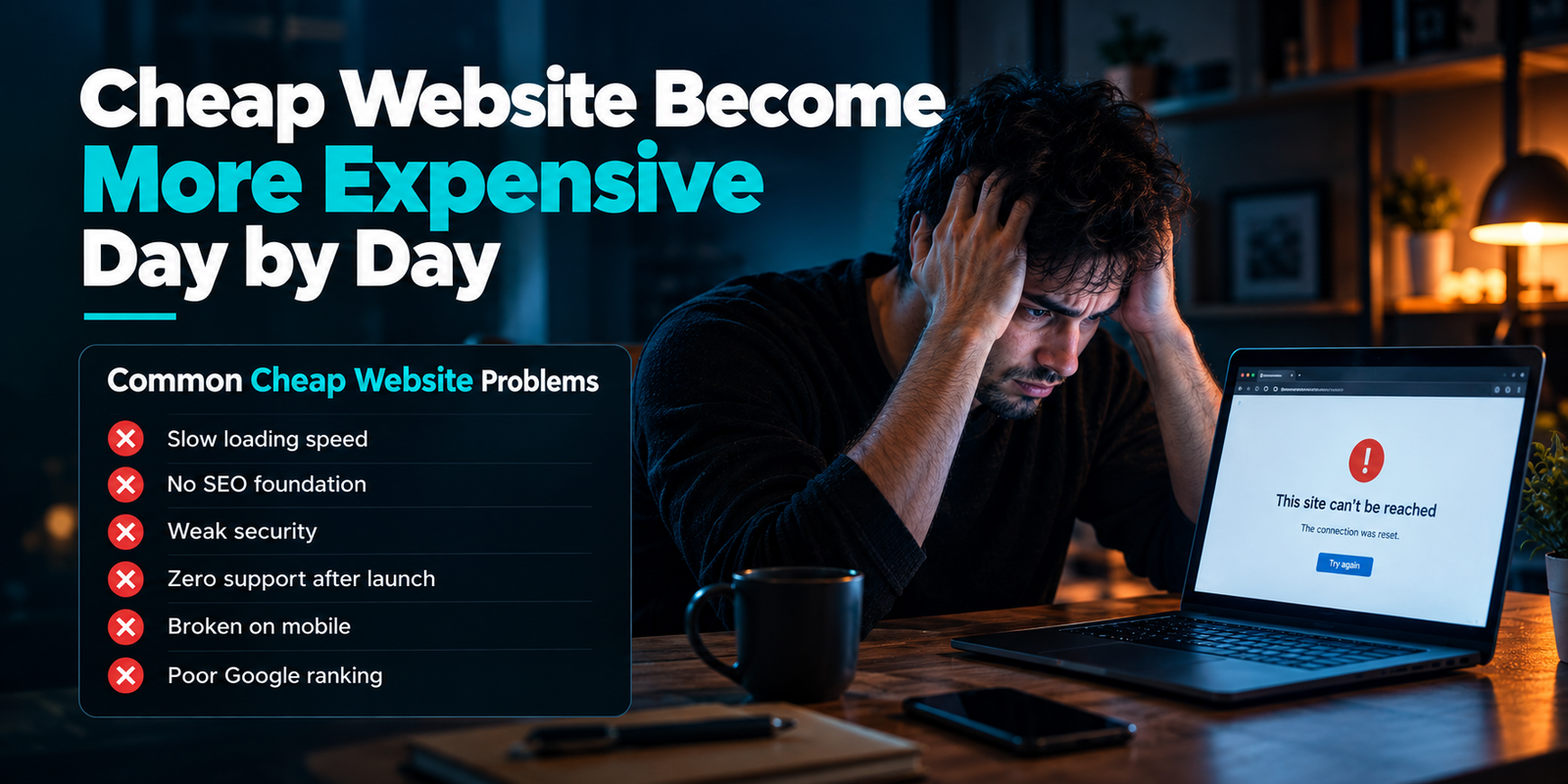
One mistake we commonly see on the client side, to be fair: treating the cheapest quote as the “smart” choice without asking why it’s cheaper. Sometimes it’s genuinely lower overhead. Sometimes it’s a signal that testing, revisions, or post-launch support have been quietly excluded from scope.
The Vetting Checklist: Portfolio, Process, Communication
Here’s the practical sequence we’d recommend running through with any shortlisted vendor.
Portfolio review
- Ask for 2–3 projects similar in complexity to yours, not just their flashiest work
- Request the live URL, not just images — check load speed, mobile responsiveness, and whether it still looks maintained
- Ask what specifically they built vs. what was templated or plugin-based (this matters a lot for WordPress/Shopify work, where “we built this” sometimes means “we configured a theme”)
Process check
- Do they use a project management tool you’ll have visibility into (Trello, ClickUp, Jira), or is progress just “trust us”?
- What does their QA step actually involve before something ships to you?
- How do they handle change requests mid-project — is there a documented process, or does it become an argument every time?
Communication check
- Response time during the sales process is a preview of response time during the project — if pre-sale replies are slow, post-contract will be worse
- Ask directly: “Who is my single point of contact, and what’s their availability relative to my time zone?”
- Request a short discovery call before quoting — a vendor unwilling to spend 20–30 minutes understanding your project before pricing it is not one you want managing scope later
We’d weight communication checks as heavily as technical checks. A technically excellent team that’s disorganized about communication will still produce a frustrating project.
Pricing Models Explained: Fixed-Price vs. Hourly vs. Dedicated Team
Pricing structure changes the incentives on both sides, so it’s worth understanding before you compare quotes.
| Model | Best for | Risk to watch |
|---|---|---|
| Fixed-price | Well-defined, smaller-scope projects (a brochure site, a single-purpose app) | Vendor may cut corners if scope was underestimated at quote time |
| Hourly/Time & Materials | Projects with evolving requirements, ongoing feature work | Costs can run open-ended without disciplined reporting |
| Dedicated team (monthly retainer) | Longer-term products needing a consistent team over months | Only cost-effective if you have enough ongoing work to keep the team busy |
In our experience, fixed-price makes sense when requirements are genuinely locked — think a defined feature list for an MVP. The moment a client says “we’ll probably want to adjust things as we go,” hourly or a dedicated-team model is the more honest structure, because fixed-price forces every adjustment into a formal (and often adversarial) change-request process.
A fair way to sanity-check any quote: ask for a rough breakdown by phase (discovery, design, development, QA, deployment) rather than accepting one lump number. A vendor who can’t break down their own estimate usually built it by guessing.
Technical Questions to Ask Every Shortlisted Vendor
Generic advice like “ask about their tech stack” isn’t useful on its own — here’s what to actually ask, and why it matters.

“What’s your typical stack for a project like mine, and why?”
The answer should map logically to your requirements. A vendor defaulting to WordPress for a project that clearly needs custom application logic (or vice versa — defaulting to a custom build for something WordPress/WooCommerce or Shopify would solve faster and cheaper) is optimizing for what they know, not what you need.
“How do you handle version control and code ownership?”
You should own the repository, full stop. Ask specifically whether you get access to a Git repo (GitHub/GitLab/Bitbucket) under your account, not theirs, with commit history intact.
“What does your QA process look like before something reaches me?”
Cross-browser testing, mobile responsiveness checks, and basic security review (input validation, SQL injection prevention on custom forms) shouldn’t be things you have to request — they should be standard.
“How do you handle hosting, SSL, and backups post-launch?”
This is where a lot of shops go quiet, because it’s the part of the job that isn’t glamorous. Get this in writing before launch, not after something breaks.
“Can I see an example of your API documentation or handover documents from a past project?”
This single question filters out a surprising number of vendors. Documentation discipline during a project usually predicts documentation discipline at handover — and a project without handover docs becomes expensive to maintain later, especially if you ever need to bring in a different developer.
Two Hypothetical Engagements: How the Right (and Wrong) Fit Plays Out
Scenario A — The Mismatch.
A Gulf-based retail business hires a Lahore-based vendor purely on price for a custom inventory management system. No discovery call happens before the quote is signed. Three weeks in, the client realizes the vendor assumed a simple CRUD app, while the actual requirement involved multi-warehouse stock syncing and barcode scanning integration. The fixed price becomes a source of constant renegotiation, and the relationship sours by month two — not because the developers were unskilled, but because scope was never properly defined upfront.
Scenario B — The Fit.
A SaaS founder needs an MVP built in 10 weeks with a defined, locked feature list. The vendor runs a proper discovery phase, produces a scope document the founder signs off on, and quotes fixed-price against that document — with change requests explicitly priced separately from day one. The project ships close to on schedule, and because the scope conversation happened early, there’s no ambiguity to argue about later. The founder isn’t happier because the vendor was cheaper; they’re happier because expectations were set correctly before money changed hands.
The pattern in both cases is the same lesson from earlier in this guide: the discovery phase is where projects succeed or fail, long before a single line of code is written.
Software House vs. Freelancer vs. In-House Team
None of these is universally “better” — the right choice depends on project duration, complexity, and how much ongoing product work you expect.

Choose a freelancer when:
- The scope is small and well-defined (a landing page, a script, a minor fix)
- You’re comfortable managing the project yourself with no PM layer
- Budget is the primary constraint
Choose a software house when:
- The project needs multiple disciplines (design + dev + QA) working in coordination
- You want accountability that doesn’t disappear if one person is unavailable
- You need documentation and process for future maintainability
Choose an in-house team when:
- Software is core, ongoing, and central to your business (not a one-off project)
- You need day-to-day control over priorities that shift weekly
- Budget supports full-time salaries, benefits, and management overhead
A software house in Lahore tends to sit in a useful middle ground for businesses that need agency-level structure without the overhead of building an internal engineering team from scratch — particularly for companies outside Pakistan who don’t have local hiring infrastructure to begin with.
Working With a Software Company in Pakistan Remotely
Remote engagement across time zones and borders raises legitimate, practical questions — here’s how to handle the main ones.
Time zone overlap. Pakistan Standard Time (UTC+5) overlaps well with Gulf business hours and has a partial overlap with European mornings. For US-based clients, expect asynchronous communication for the most part, with occasional early-morning or late-evening calls on either side. Ask upfront how the vendor handles this — a team that insists on real-time calls for every update will be a poor fit for a large time-zone gap.
Contracts and IP ownership. Get a written agreement that explicitly states you own the code, design assets, and IP upon final payment — not just “you can use it.” International clients should also confirm whether the vendor operates under a registered business entity, since this affects what legal recourse exists if something goes wrong.
Payment methods. International wire transfer, Payoneer, and platforms like Wise are common for cross-border payments to Pakistani vendors. Confirm currency (USD quotes are standard for international clients) and who absorbs transfer fees — this is a small detail that’s easy to overlook and mildly annoying to argue about later.
NDAs. A legitimate software company in Pakistan should have no issue signing a standard NDA before you share proprietary requirements or data. If a vendor pushes back on this, treat it as a red flag on par with the ones covered earlier in this guide.
After Launch: Support, Maintenance, and Scaling
The project doesn’t end at launch, even though a lot of contracts are written as if it does.
What “support” should actually include:
- Bug fixes for issues traceable to the original build (not new feature requests disguised as bugs)
- Security patching and dependency updates, especially for CMS-based sites (WordPress in particular needs regular plugin/core updates or it becomes a security liability)
- Uptime monitoring, or at minimum a clear answer for who to call if the site goes down
What commonly gets left out of “support” packages — worth clarifying before you sign:
- Server/hosting costs (often separate from the dev retainer)
- New feature development (support usually covers maintenance, not growth)
- Third-party API changes that break integrations you didn’t build in-house
In our experience, the cleanest arrangement is a defined monthly maintenance retainer with an explicit list of what’s included, rather than an informal “we’ll take care of you” verbal promise. If you plan to scale the product significantly post-launch — more users, new modules, mobile app expansion — ask the vendor directly whether their team has handled that kind of scaling before, and ask for a specific example rather than a general “yes, we can handle growth.”
FAQs
How much does it cost to hire a software house in Lahore?
Costs vary widely by project complexity and vendor tier, generally landing well below US/UK/EU rates for comparable work. Always ask for a phase-by-phase breakdown rather than comparing single lump-sum quotes, since scope definitions differ between vendors.
Is it safe to hire a software company in Pakistan for an international project?
Yes, with standard precautions: a written contract, clear IP ownership terms, an NDA before sharing sensitive data, and milestone-based payments rather than full upfront payment. Many Pakistani agencies, including those in Lahore, work regularly with international clients across the Gulf, Europe, and North America.
What’s the difference between a software house and a digital marketing agency?
A software house focuses on building products — web development, apps, custom systems. A digital marketing agency focuses on promoting existing products through SEO, ads, and content. Some firms, like Websphere Hub, offer both under one roof, which can simplify handoffs between “build” and “grow” phases.
How long does it take to build a custom software project?
It depends entirely on scope — a basic website might take 3–4 weeks, while a custom SaaS MVP often runs 8–16 weeks. Any vendor giving you a timeline before a proper discovery/scoping phase is estimating without real information.
Should I choose a software house pakistan-based team over a local (onshore) developer?
It depends on budget and communication preferences. Pakistani teams often offer stronger cost-to-quality ratios and English-fluent communication, while onshore teams may offer easier in-person collaboration. For most remote-friendly projects, the deciding factor should be vetted quality and process, not just geography.
What should I look for in a software house’s portfolio?
Live, working links (not just screenshots), projects of similar complexity to yours, and clarity on what was custom-built versus templated. If a vendor can’t show live examples of relevant past work, treat that as a gap worth asking about directly.
Conclusion
Choosing the right software house in Lahore comes down to a handful of repeatable checks: verify the portfolio is real and relevant, insist on a proper discovery phase before pricing, get payment terms and IP ownership in writing, and weight communication process as heavily as technical skill. The projects that go well almost always share the same trait — scope and expectations were set clearly before any code was written.
Finding the right developers can be stressful. We’re here to help you get it right from day one. Let’s connect for a quick, friendly chat about your idea. We’ll help you structure your requirements and give you a realistic plan—completely free of charge. Click to Discuss your project with us.”