Why the Cheapest Website Can Be the Most Expensive Decision
Every business owner wants to save money. That’s not a bad instinct — it’s a smart one, most of the time. But there’s one area where “saving money” quietly turns into “losing money,” and that area is website development. A cheapest website looks like a win on the day you buy it. Six months later, it often looks like the most expensive decision you made all year.
This isn’t a scare tactic. It’s just what happens, repeatedly, to businesses that treat a website as a one-time expense instead of a long-term business asset. Let’s break down why that happens, what it actually costs, and what a smarter approach looks like.
The Real Problem: A Website Isn’t a Purchase, It’s an Investment
When you buy a chair, you get a chair. It doesn’t need updates, it doesn’t get hacked, and it doesn’t stop working because Google changed its algorithm. A website is nothing like that.
A website is a living, working part of your business. It needs to load fast, look right on every device, rank on search engines, stay secure, and actually convert visitors into customers. A cheap website usually fails at several of these at once — not because the developer was lazy, but because a low price simply doesn’t leave room for the work that quality requires.
When someone offers you a website for a fraction of the market rate, they’re not doing you a favor. They’re cutting corners somewhere, and you just don’t know where yet. Sometimes it’s the code. Sometimes it’s the design. Sometimes it’s what happens after they get paid — meaning nothing happens at all.
The Hidden Cost Behind the Cheapest Website
1. Poor Code Means Poor Performance
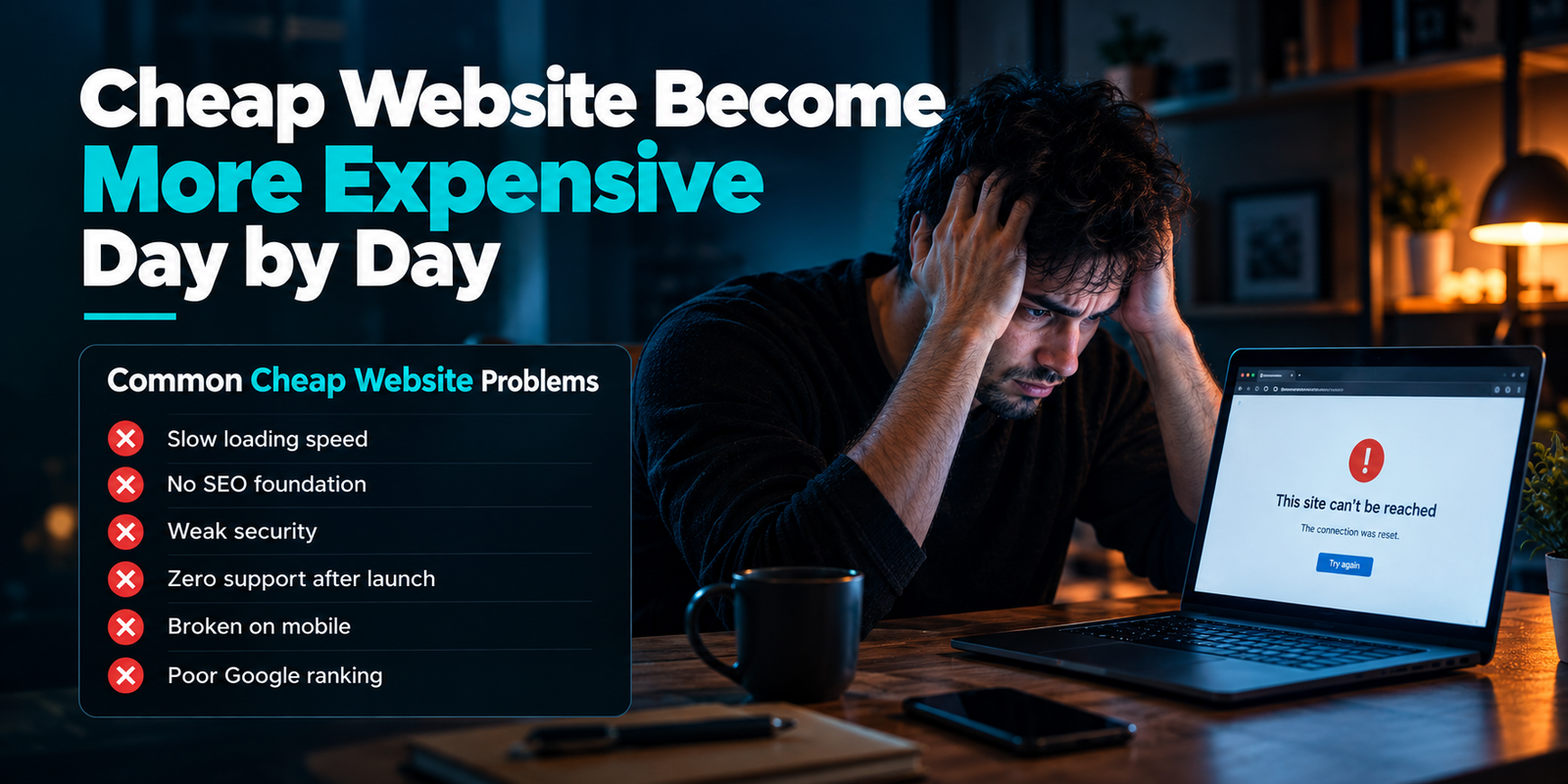
A rushed website is usually built on shortcuts — bloated themes, unnecessary plugins, copy-pasted code, and no real structure behind it. This shows up as slow load times, broken layouts on mobile, and pages that crash under normal traffic.
Google penalizes slow websites. Customers abandon slow websites. So a site that was “cheap” to build ends up costing you visitors and sales every single day it stays online.
2. No SEO Foundation
This is the part most business owners don’t realize until it’s too late. A website built without SEO in mind is invisible. It doesn’t matter how nice it looks if nobody finds it.
Proper on-page structure, clean URLs, optimized headings, fast load speed, mobile responsiveness, and quality content all play a role in ranking. Cheap website packages almost never include this — because doing it properly takes time, and time is exactly what a rock-bottom price doesn’t allow for.
If you’ve ever wondered why your competitor’s website shows up on Google and yours doesn’t, this is usually the answer.
3. Security Gets Ignored
Cheap websites, especially ones built quickly on WordPress without proper configuration, are often left exposed. Outdated plugins, weak hosting, no firewall, no monitoring — this is a hacker’s ideal target.
When a website gets hacked, the real cost isn’t just the fix. It’s downtime, lost customer trust, and sometimes your entire site getting blacklisted by Google. At that point, you’re not paying for a cheap website anymore — you’re paying for damage control, and that bill is always higher.
4. No Support After Launch
A huge number of “cheap website” deals disappear the moment the invoice is paid. No maintenance, no updates, no one to call when something breaks. The business owner is left alone with a site they don’t understand and can’t fix.
This is when most people end up hiring a second developer to fix what the first one built — and paying for the same website twice.
The Website Development Cost Conversation Nobody Has Honestly
Here’s something that needs to be said plainly: website development cost isn’t random. It reflects the actual work involved — planning, design, development, testing, SEO setup, and post-launch support.
When you compare quotes and see a massive price gap, that gap represents missing work, not “efficiency.” A fair price for professional web development services covers:
- Custom design instead of a generic, overused template
- Clean, maintainable code
- Mobile optimization and cross-browser testing
- On-page SEO setup from day one
- Basic security hardening
- A short training or support period after launch
When any of these are missing, the price drops — but so does the value. You’re not getting a discount. You’re getting a smaller, incomplete version of what you actually need, and you’ll likely pay to complete it later anyway.
Why WordPress Gets Blamed (When the Real Issue Is Execution)
WordPress powers a huge share of the internet, and for good reason — it’s flexible, scalable, and cost-effective when done right. But it’s also the platform most abused by cheap website builders, because it’s easy to throw together something that looks functional without understanding what’s happening underneath.
Proper WordPress development services involve more than installing a theme and a few plugins. It means choosing the right theme architecture, writing custom functionality where needed, optimizing the database, securing the login and admin areas, and making sure the site is genuinely fast — not just fast in a demo video.
A badly built WordPress site and a well-built WordPress site can look nearly identical to a client on day one. The difference only shows up later, in load times, in search rankings, and in how much it costs to fix things down the road.
The Local Angle: Why Working With a Real Software House Matters
If you’re a business owner searching for a software house in Lahore or anywhere else, you’ve probably already noticed the huge range in pricing — some quotes are ten times higher than others for what looks like the same service. That gap almost always comes down to process.
A proper software house has a team — designers, developers, QA, and support — working within a real process. A freelancer working from a shortcut template, or an unregistered “agency” that’s really one person juggling ten clients, cannot offer the same reliability, simply because there’s no structure behind the delivery.
That doesn’t mean every affordable option is bad, or every expensive one is good. It means you should be asking what’s actually included, who will support the site after launch, and whether the team has a real portfolio of live, working websites — not just design mockups.
What This Actually Costs You Over Time
Let’s put this in real terms. A business that buys a cheap website often ends up:
- Paying a second developer to fix bugs and structural issues
- Losing months of potential Google ranking because SEO wasn’t set up correctly from the start
- Losing customer trust after a slow or broken site drives visitors away
- Paying separately for security cleanup after a hack
- Rebuilding the entire site within a year or two because it can’t be scaled or properly updated
Add all of that up, and the “cheap” website ends up costing two or three times more than a properly built one would have cost in the first place — and that’s not counting the lost business along the way.
What a Smarter Approach Looks Like
None of this means you need to spend an unreasonable amount on a website. It means you need clarity on what you’re paying for. A smart approach looks like this:
- Ask what’s included, in detail. Design, development, SEO setup, mobile testing, and support should all be specified — not assumed.
- Ask about the platform and why it was chosen. Whether it’s WordPress, a custom build, or an e-commerce platform, there should be a clear reason it fits your business.
- Ask about post-launch support. A website is never really “done.” Ongoing updates, backups, and security checks matter.
- Look at real, live examples. Not screenshots — actual working websites you can visit, click through, and test on your phone.
- Treat the budget as an investment, not an expense. A website that brings in customers pays for itself. A website that sits there unseen never does.
The Bottom Line
Cheap websites aren’t a shortcut to savings — they’re a delay of cost, dressed up as a discount. The bill always comes due eventually, whether it’s in lost search rankings, lost customers, security problems, or a full rebuild.
A website built properly, with real web development services, proper SEO groundwork, and reliable WordPress development services behind it, isn’t the “expensive” option. It’s the option that actually works — and that, in the long run, is the cheapest choice you can make.
If you’re planning to build or rebuild a website, the real question isn’t “how little can I spend?” It’s “what am I actually getting for what I spend?” That one shift in thinking is usually the difference between a website that grows your business and one that quietly holds it back.