Custom AI Chatbot Development Services
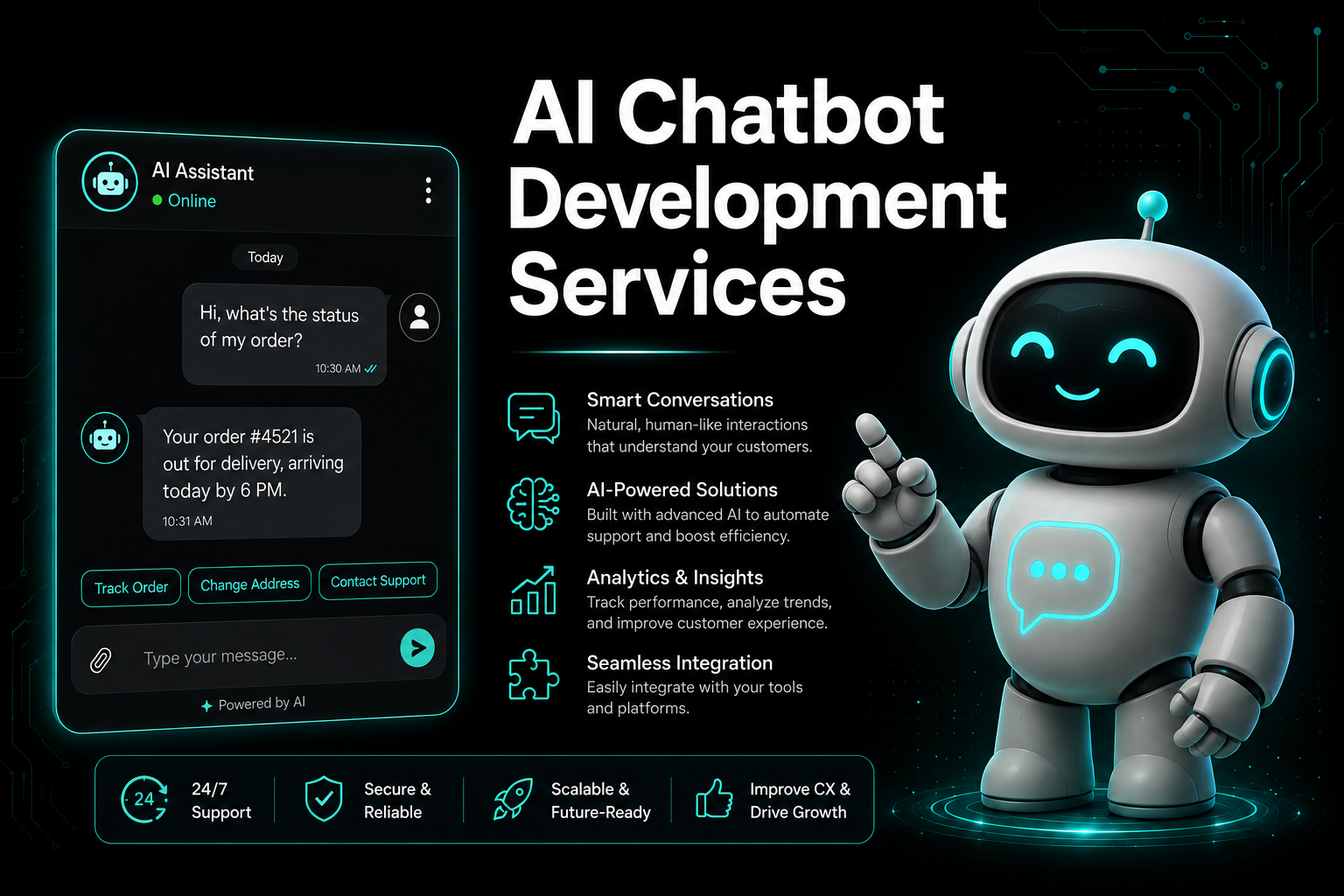
If you have a team that is still answering the same 5 questions 40 times a day, you’re not providing customer support, you’re creating a bottleneck. Websphere Hub’s AI chatbot development services help US businesses get rid of that burden: chatbots trained on your business data, integrated into your existing systems, and live on any platform your customers use – your website, app, or WhatsApp.
We develop for businesses all over North America, whether they’re just a single service in one location or they have a distributed SaaS or enterprise development team — and we work US hours when they need them, async otherwise. From a simple lead-capture bot to a complete enterprise deployment across the various departments, chances are we’ve built something similar before.
What Is an AI Chatbot, Really?
It’s a term that’s used loosely, so be careful to be exact. A simple chatbot acts on a decision tree — click on a button, receive a canned response, end up with a dead end once the response doesn’t match a script. An AI chatbot is different: it can grasp natural language, maintain context throughout a conversation, and extract responses from real data, instead of being stuck with a limited set of canned scenarios.
The difference is important because it’s between a tool that makes people mad and one that makes them happy to use over waiting on hold. The vast majority of the “we tried a chatbot and it didn’t work” tales that businesses tell have been about the first type: a rule-based ‘widget’ sold as AI. What sets apart a truly helpful assistant from an FAQ drop-down is the technology that lies beneath it. It is the technology behind it (RAG, large language models, proper system integration) that makes the difference between a useful assistant and a glorified FAQ drop-down.
Do You Actually Need One?
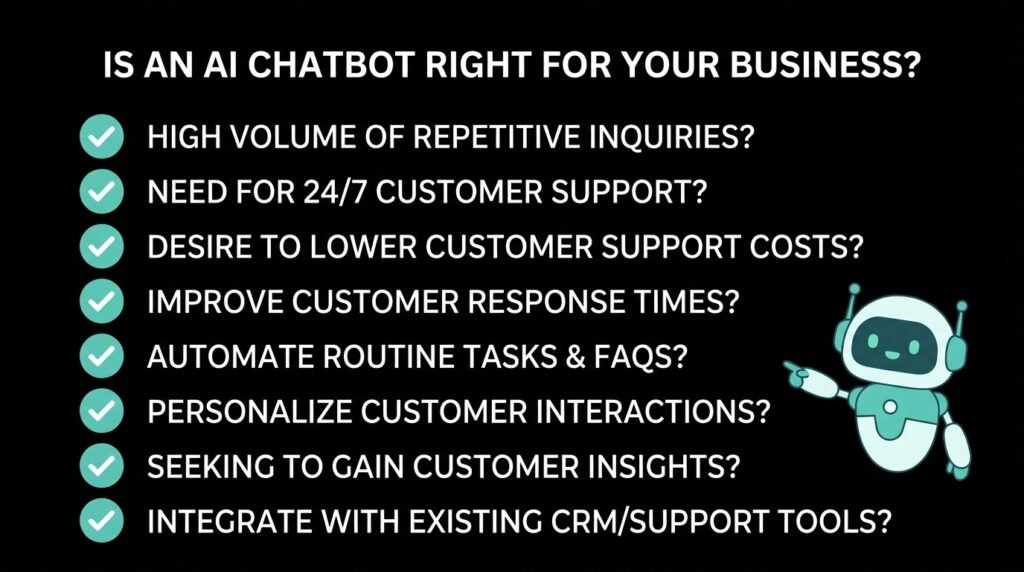
Not every business needs one, and it is important to be honest about that before investing. A chatbot is likely to be a worthwhile investment if it meets some of the following conditions:
- Your team is constantly answering the same few questions, such as order status, pricing, availability, policy details, etc.
- A significant portion of enquiries come in outside business hours and just sit unanswered.
- Follow up is not immediate and leads go cold.
- Support and/or sales staff increases with the volume – not keeps flat at scale.
If none of this sounds familiar, maybe you receive a few questions per week and get to respond to them yourself — it’s probably not the time to invest in a chatbot. Once it rings a bell, the chances are that it’s time AI chatbot development services begin to pay off financially.
What We Build
You can get your repetitive customer support questions answered quickly by a customer support chatbot, and pass the more judgmental tasks onto a human when they require it. The agent retains the entire conversation history so no one’s asking the customer to repeat any of the above.
Chatbots in the right places: pricing pages, product pages, checkout. They qualify leads according to your criteria, collect contact information and feed it into your CRM — and at 2am on a Saturday as well as 2pm on a Tuesday.
Internal workflow bots for stuff that happens behind the scenes, such as HR onboarding questions, IT helpdesk tickets, document lookups. Rather than your employees emailing three people to get one answer, they email the bot, and get to the next thing.
What Makes a Chatbot Actually Useful
A chat widget can be easily set up by anyone in an afternoon. It takes real engineering to get one that understands your business, connects to your systems, and knows when to get out of the way and call a human.
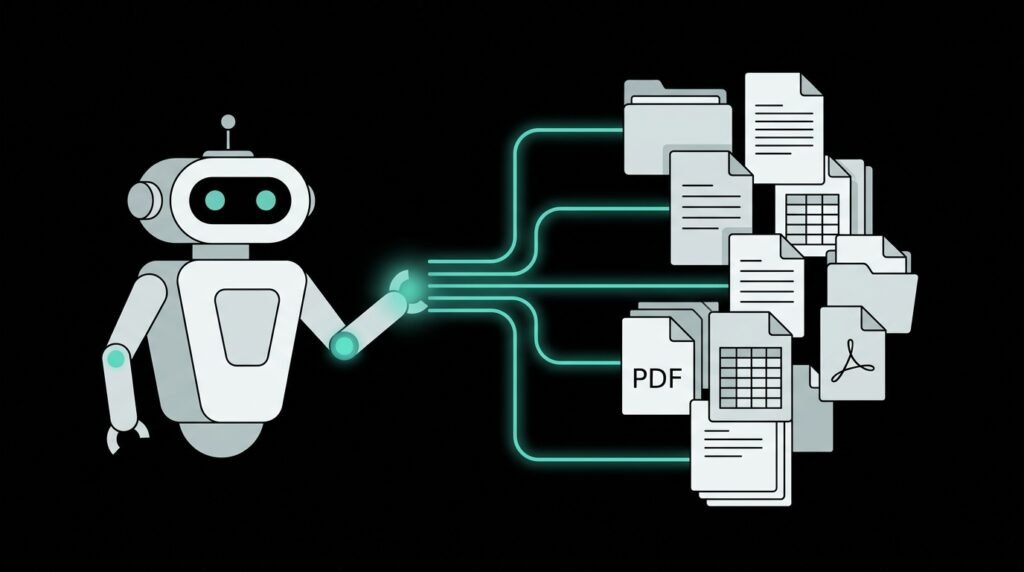
Retrieval-Augmented Generation (RAG). This is the distinction between a bot that has been guessed by someone and a bot that knows. We don’t use generic training data – we link the chatbot to real documents, whether these be product catalogues, policies, pricing sheets, support manuals, etc., so that every answer you get comes from a real document. Automatically update your knowledge base, without requiring a rebuild of the bot.
CRM & ERP integration. We connect the chatbot directly to your Salesforce, HubSpot, Zendesk, Zoho or any other legacy ERP your business uses, so that leads, chats and order information seamlessly moves into your system. No manual re-entry, no gaps between Bot’s knowledge and team’s sight.
Conversation memory. The customer shouldn’t be required to explain their situation three times. Our bots are aware of the context throughout the conversation — a person tells the bot they are running a restaurant, and they ask in the second part of the conversation what the price is, the bot already knows that they are talking to a restaurant owner.
Human handoff without the “re-do”. The handoff happens in just a second when the conversation requires a human touch (such as a complaint, a technical edge case, a large sale), and the agent sees the complete transcript before they type a word.
Multi-platform by default. All of this, using one backend: website, mobile app, WhatsApp, Messenger, Instagram — one brand voice, everywhere, with multi-language support (Spanish is included) when your customers need it.
Built for Enterprise, When You Need It
But for some businesses, a support widget is not enough, they require infrastructure that is not going to crumble when it’s needed, properly processes sensitive information, and integrates with systems that were never intended to communicate with an AI moderated support chatbot.
Architecture that scales. Our enterprise deployments scale up and down with traffic: you don’t pay for capacity you don’t need — and you don’t watch the response times slow down during a launch or a sales.
Personal data grounding and compliance. All your documents and business data remain within your own infrastructure: not used for training external models, not communicated beyond your controlled environment. We include compliance with HIPAA, SOC 2 and GDPR in every project we build for regulated industries, and other features like encryption, audit logs and role-based access are mandatory before we can even begin any project for the clients in the healthcare, fintech, and legal industries.
Model flexibility. We’re not locked into one AI provider. For complex reasoning tasks, GPT-4o (general purpose) is suitable, while Claude is ideal for tasks that require tone and nuance rather than sheer power; for businesses that need everything on their own infrastructure, Llama is the option. Some customers have a hybrid — one of the cheaper services for internal automation and one of the more expensive for customer-facing chat. We customize whichever model you may select, to your actual business language, rather than corporate-speak.
Industries We Build For
E-commerce & retail — product recommendations, size and stock questions, checkout assistance, order tracking and post-purchase follow-ups that convert one-time customers into repeat customers.
Healthcare — appointment scheduling, prescription and billing information inquiries, and general symptom questionnaires to direct patients to the appropriate next steps, with HIPAA-compliant data security.
Real Estate – Property Search, Viewing Appointments booked directly into your calendar, and Lead Qualification (qualifying serious buyers vs window shoppers).
Education – admissions enquiries, advice about enrolments, timetables and usual enquiries by parents and students that could take up front office time.
Logistics & supply chain — shipment tracking at a snap, handling requests for “where is my order?” and warehouse and dispatch internal tools.
How We Build It
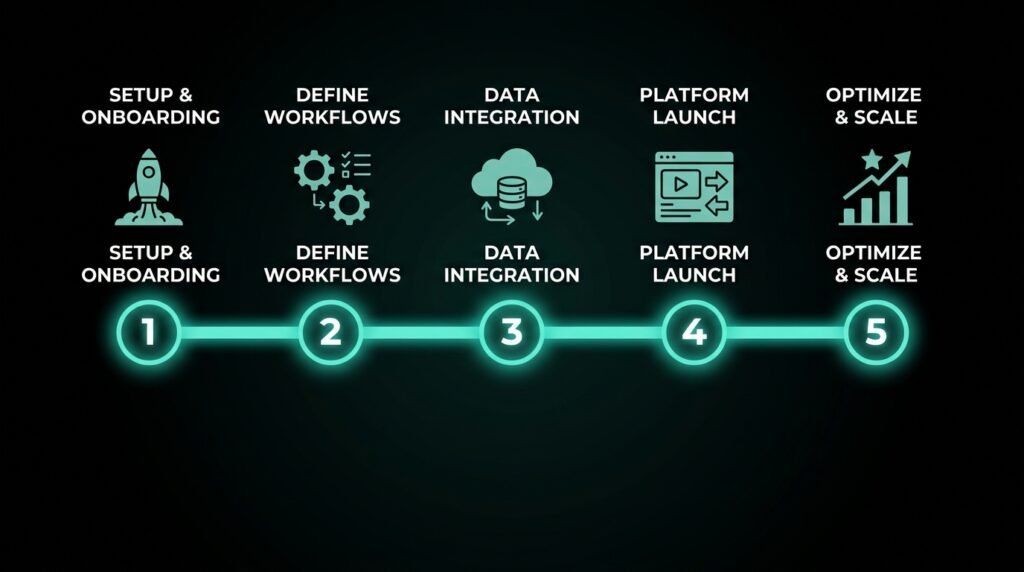
1. Discovery. We convene your team (support, sales, ops, anyone who knows the issue best) and get to the bottom of what is really consuming time. Not all use cases are created on day one – we need to focus on what will have the most impact for the most people, the quickest.
2. Architecture & flow design. We trace actual conversation paths that your bot should manage and design the connection between your bot and your CRM/ERP/helpdesk and plan how your knowledge base is going to be structured for RAG retrieval.
3. Build & training. The bot is created and trained with your own real business information, and is branded with your website’s colors, tone and voice. We test it against edge cases you actually experience, not theoretical ones.
4. Testing & launch. Load testing, security testing and user acceptance testing all happen before anything goes live. Most clients prefer a phase-two approach, running one channel in the first phase then scaling up once we’re sure it’s working ok.
5. Ongoing optimization. The finish line is not the end of the journey with Launch. We monitor what the bot does well, where humans take over and where they fall out of a conversation and use that to continuously improve the bot.
What Businesses Actually Get From This
Coverage outside of business hours. A visitor at midnight will be answered, not a contact form that promises a response “within 24 hours”. The after-hours lead capture is usually a significant improvement for clients with 24/7 chatbot support, as they are more likely to convert leads that they’ve had in their queue, but would have otherwise lost to a competitor who responds quicker.
Lower support costs. Many support tickets are the same few questions over and over again: status of order, returns, access to accounts. After it absorbs those, your team’s time is channeled to those tickets that really require a human, and the number of tickets usually halves or more.
Better lead conversion. Businesses can’t afford to be slow. This is because a lead that engages immediately and qualifies on the spot has a significantly higher conversion rate than a lead that just submits a “we’ll be in touch” form; a bot’s persistence in following up with timely, contextually relevant messages, brings leads back to life who otherwise would have gone cold.
How Much Does an AI Chatbot Cost?
There is no single answer: cost varies based on the number of conversation flows, the number of systems it needs to integrate with, and the level of training and support you seek and require over the long haul. A general rule of thumb: A simple website chatbot to respond to FAQs and collect leads falls in the low thousands, a website chatbot that integrates with CRM and deploys on multiple platforms is priced higher, and a full enterprise build with custom integrations and compliance work is a custom price that varies widely based on the requirements. Our Packages section below categorises this by level, so you can see an approximate position of your business before discussing the details of the pricing.
Why Websphere Hub
Websphere Hub developed and launched chatbots for clients in the USA in e-commerce, SaaS, healthcare, logistics, and many other sectors, along with businesses based in the Middle East and Europe. These are systems that are deployed in production and processing real conversations on a day to day basis; these are not proof-of-concept demos.
No templates. Each chatbot is created around your actual workflow, your actual systems, and your actual customer questions — not a generic flow that technically works, but does not fit the way you run your business. You control what we create, no vendor lock-in and no growing subscription fee due to usage.
Post-launch engagement. When the business changes, your chatbot needs to change, whether it’s a new product, a new policy or a seasonal campaign. We track performance, identify where the bot is failing, and continually improve it—don’t let it silently deteriorate over time!
Packages
Starter — Small Business Automation
Starter is an automation platform for small businesses.
Fully 15 conversation flows for product info, pricing, contact capture and basic troubleshooting. Instructed by documentation and FAQs you supply, leads are sent via email or placed right into a simple CRM (Google Sheets, Mailchimp, etc.). Customizable chat widgets with your website branding. Self deployed in 2-3 weeks, monitoring 30 days after deployment.
Ideal for: local service providers and small businesses in the United States that are just starting to adapt automation.
Professional — CRM-Integrated Solution
Sales, support and booking up to 40 conversation flows, full CRM integration (Salesforce, HubSpot, Zoho, Pipedrive, Zendesk). Lead qualification based on intelligence, seamless human handoff with full context transfer and multi-platform deployment (website, WhatsApp, Messenger, Instagram). Delivered in 4-6 weeks including 90 days of active optimization.
Ideal for: growing businesses with active sales or support teams and genuine inquiries.
Enterprise — Full Automation Suite
Unlimited conversation paths between departments, custom integration of legacy or proprietary system, private data grounding with GDPR/HIPAA/SOC 2 compliant systems and fine-tuning of different LLMs. Features sentiment analysis, predictive lead scoring and white-label options for agencies or SaaS platforms. Installed in 8-12 weeks with committed account support.
Ideal for: Companies with multiple departments, high interaction counts, or compliance requirements.
Need help determining which tier is right? Give us a general idea of the number of conversations you’re managing per month and we will direct you to the appropriate one.
Frequently Asked Questions
What does an AI chatbot development company do?
Creates, builds, trains and deploy custom chatbots to support, sell and automate processes, using your business data and integrated with your current CRM, ERP or helpdesk tools.
What is the price of developing an AI chatbot for custom services?
Depends on scope. The Starter version is for small businesses with simple requirements, the Professional version is for expanding teams that require CRM integration and multi-platform deployment, and the Enterprise version is custom-tailored for businesses with large multi-department needs.
What is the duration of the build?
Starter: 2–3 weeks. Professional: 4–6 weeks. Enterprise: up to 12 weeks, depending on integration complexity.
What’s the difference between a rule-based chatbot?
Rule-based bots operate on a set of decision trees and interrupt when the conversation deviates from the rules. Our own leverage RAG and large language models that comprehend natural language, maintain context, and retrieve answers from your actual data.
Will it fit in with my current CRM or ERP?
Yes — Leads, tickets and conversations log automatically in Salesforce, HubSpot, Zoho, Zendesk and most custom/legacy ERP systems.
Compliant with HIPAA and SOC 2?
Yes, if it is necessary for your project. Healthcare, fintech, and regulated US businesses encrypt in transit & at rest, log all changes, and implement role-based access to data, all within HIPAA, SOC 2, and GDPR compliance.
Is my business data safe?
Yes. Private data grounding – your knowledge base remains within your infrastructure and is never used for external models training.
Are you a direct business partner of U.S.-based businesses?
Yes — we accept calls and check-ins in US time zones, and we have the development team doing async between, so it’s still cost effective without having to slow down communication.
Which type of AI model are you using?
Whether it’s GPT-4o, Claude, Llama or a combination, instead of choosing one provider.