Choosing the Right Software House in Pakistan in 2026
Choosing the right software house in Pakistan can make a significant difference to your business. The right development partner can help you build reliable software, streamline business operations, and bring your ideas to life.
However, choosing the wrong company can lead to missed deadlines, unexpected costs, poor-quality code, and ongoing maintenance problems. Before hiring a software development company, it is important to understand its services, pricing, technical expertise, and project management process.
In this guide, we will cover:
- What a software house in Pakistan actually does
- How to evaluate potential development partners
- What software development projects may cost
- Key warning signs red flags to watch out for
Finally, we will also explore how Websphere Hub helps businesses build scalable and reliable software solutions.
What a Software House Actually Does
A software house is a company that builds digital products for other businesses instead of building its own product to sell. That’s the simplest definition, and it covers a wide range of work.
In practice, a software development company in Pakistan might be doing any combination of the following on a given week:
- Building a custom web application for a logistics company that needs route optimization
- Designing and developing a mobile app for a retail brand launching in a new market
- Maintaining legacy code for a client whose original developer disappeared
- Running UI and UX work for a SaaS product before a funding round
- Handling SEO and digital marketing for a client who already has a working product but no traffic
The term gets used loosely. A two-person freelance team working out of a shared office in Lahore might call itself a software house, and so might a 300-person company with offices in three cities. Neither description is wrong, but it matters a lot which end of that spectrum you’re hiring.
In our experience, the companies that last and build repeat business are the ones that treat software development as a process with documentation, testing, and accountability built in, not just a group of people who can write code. Writing code is the easy part. Managing scope, communicating delays honestly, and maintaining what you built after launch is where most vendors fall apart.
The Current State of Pakistan’s Software Industry
Pakistan’s IT sector has grown steadily over the past decade, driven largely by remote work demand from the US, UK, and Middle East, and supported by platforms like Upwork and Fiverr where Pakistani freelancers and agencies have built a strong reputation. The Pakistan Software Export Board (PSEB) has tracked consistent year over year growth in IT exports, though exact figures shift with currency fluctuation and reporting periods .
Lahore, Karachi, Islamabad, and Rawalpindi remain the main hubs, with a growing number of smaller teams operating out of Faisalabad, Multan, and Peshawar as remote hiring normalized after 2020. This geographic spread is relevant because it means price and quality no longer correlate neatly with city size the way they did ten years ago.
What this growth has also created is noise. For every established company with a track record, there are dozens of newly registered entities with a polished website and no delivered projects to show for it. We’ve had potential clients tell us they contacted five “software houses” in Pakistan and received five almost identical quotes with almost no differentiation in the pitch, just price undercutting.
This is the environment buyers are actually operating in. It’s not that good companies are rare, it’s that distinguishing them from a landing page with stock photos takes more effort than it should.
A few structural things worth knowing if you’re evaluating vendors here:
- Most serious companies are registered with the Securities and Exchange Commission of Pakistan (SECP) and many are also PSEB registered, which is worth asking about directly
- English is the standard business language for client communication, which reduces friction compared to some other outsourcing destinations
- Time zone overlap with the US is limited Pakistan is typically 9 to 10 hours ahead of US Eastern Time, so async communication processes matter more than they would with a nearshore vendor
- Payment is commonly handled through Payoneer, wire transfer, or platforms like Upwork Escrow for smaller engagements
How to Identify the Best Software House in Pakistan for Your Project
There is no single best software house in Pakistan for everyone. The right fit depends on your budget, the complexity of what you’re building, and how hands-on you want to be during development. What you can do is apply a consistent filter.
Start with portfolio relevance, not portfolio volume. A company that has built fifty WordPress brochure sites isn’t automatically qualified to build a React Native app with real time syncing. Ask specifically for projects similar in complexity and industry to yours, and ask what the vendor’s actual role was on each one. Sometimes an agency shows a project it only did design work for, not development.
Ask how they structure teams. Some companies assign a dedicated team to your project for its duration. Others pull from a shared pool of developers across multiple clients, which can mean inconsistent availability. Neither model is inherently bad, but you should know which one you’re getting before you commit.
Check their process for handling scope changes. This is one we push hard on with every prospective client conversation. Projects change. Requirements shift once stakeholders see a working prototype. A company that has no documented process for change requests will either eat the cost silently and resent you for it, or quietly extend the timeline without telling you why.
Look at communication cadence before signing, not after. How quickly do they respond to your initial inquiry? Do they ask clarifying questions about your business goals, or do they jump straight to a quote? In our experience, the quality of pre-sales conversation is a fairly reliable predictor of post-sales communication.
Verify legal and compliance basics. Ask for their SECP registration number, NTN, and whether they can sign an NDA and a Master Services Agreement before any detailed discussion. A legitimate software development company in Pakistan will have these ready without hesitation.
What Separates a Top Software House in Pakistan From an Average One
We’ve worked alongside, competed with, and occasionally inherited projects from other local companies. The gap between an average vendor and a genuinely strong one usually comes down to process discipline rather than raw technical talent. Pakistan has no shortage of capable developers.
A few things we consistently see in stronger teams:
Structured project management. Agile or Scrum isn’t just a buzzword to drop in a sales pitch. It means sprint planning, a visible backlog, regular demos, and retrospectives that actually change how the next sprint runs. If a vendor can’t explain their sprint cadence or show you a sample sprint board, that’s worth noting.
Code review as a standard step, not an afterthought. One developer writing code that nobody else reviews is a liability. If the person leaves mid-project, which happens more often in this industry than clients realize, an undocumented, unreviewed codebase becomes very expensive to hand off.
Written documentation at every stage. Requirement documents, API documentation, deployment guides. A top software house in Pakistan treats documentation as part of the deliverable, not an optional extra you have to request after launch.
Testing that goes beyond “it works on my machine.” This includes browser and device testing, load testing for anything expecting real traffic, and a QA phase that’s separate from development, ideally handled by someone other than the developer who wrote the feature.
Transparent reporting. Weekly or bi-weekly updates that include what was completed, what’s blocked, and what’s coming next. Not a generic “progress is good” message with no specifics.
None of this is exotic. It’s standard practice in mature software teams anywhere in the world. The companies that consistently deliver well in Pakistan are simply the ones that apply these basics without cutting corners under deadline pressure.
Software Development Company vs Independent Freelancers
This comparison comes up in nearly every initial client call we have, usually framed as “why should I pay more for an agency when I can hire a freelancer for less?”
It’s a fair question, and the honest answer is: it depends on what you’re building and how much risk you can tolerate.
Where freelancers make sense:
- Small, well-defined tasks with a clear scope a landing page, a bug fix, a small script
- Short timelines where you don’t need multiple skill sets
- Lower budget projects where some risk is acceptable
Where a software development company in Pakistan is generally the safer choice:
- Projects requiring multiple disciplines at once backend, frontend, design, QA
- Anything with a long post-launch maintenance requirement
- Projects where business continuity matters, since an agency has backup resources if one person is unavailable
- Work involving sensitive data or compliance requirements that need formal contracts and accountability
The real risk with freelancers isn’t skill, many are excellent. It’s continuity and accountability. If a freelancer takes another contract, gets sick, or simply stops responding, you have limited recourse. An agency has internal processes to reassign work and keep a project moving, backed by a registered legal entity you can actually hold to a contract.
We’ve inherited more than a few projects that started with a freelancer and were handed to us half-finished, with no documentation and code that only the original developer fully understood. Rebuilding institutional knowledge from scratch almost always costs more than hiring the right partner from the start would have.
Core Services You Should Expect From a Reliable Partner
A capable software house in Pakistan today needs to offer more than development alone, because most clients need the full lifecycle of a digital product handled by people who understand how the pieces connect.
Custom web development. This covers everything from business websites to complex web applications with custom backends, APIs, and database architecture. A good partner will tell you honestly when a simpler platform like WordPress Development or Shopify will serve your needs better than custom code, instead of pushing custom development because it’s more profitable for them.
Mobile app development. Native development Swift for iOS, Kotlin for Android versus cross platform frameworks like Flutter or React Native is a decision that should be based on your budget, timeline, and feature complexity, not on what the agency happens to specialize in. Ask them to explain the trade-off for your specific case.
UI and UX design. This is frequently underweighted in budget discussions, but a poorly designed interface undermines solid backend engineering. Look for a design process that includes user research or at least competitor analysis, wireframing, and usability testing before any code is written. Our team at Websphere Hub treats this as a separate phase with its own sign-off, not something bundled loosely into development.
SEO and digital marketing. A product nobody can find isn’t solving a business problem. Technical SEO site speed, structured data, crawlability should be built in during development, not bolted on afterward as a separate project months later.
Quality assurance and testing. Manual and automated testing, cross browser compatibility, and performance testing under realistic load conditions.
Post-launch support and maintenance. Bug fixes, security patches, server monitoring, and feature iteration based on user feedback. Ask explicitly what’s included in the maintenance period and what counts as a billable change request.
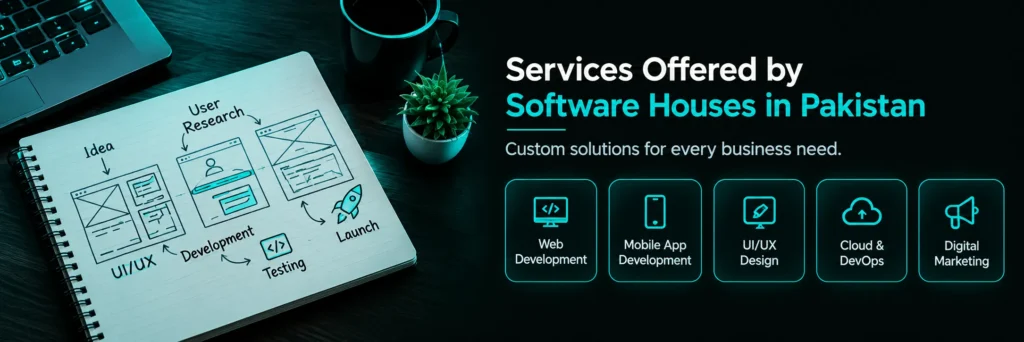
If a prospective vendor only offers one or two of these in-house and outsources the rest quietly, that’s not disqualifying, but you deserve to know about it upfront so you understand who’s actually accountable for each part of your product.
Red Flags We’ve Seen When Evaluating Vendors
Some of these are things we’ve been told directly by clients describing bad experiences elsewhere. Others are patterns we’ve noticed while reviewing inherited codebases.
- Quotes that come in significantly below every other bid without a clear explanation of what’s being cut. Someone is absorbing that cost difference, usually through corners cut on testing or by using junior developers without supervision.
- No written contract or Statement of Work before development starts. Verbal agreements about scope and timeline are not enforceable and almost always lead to disputes later.
- Reluctance to share verifiable client references. A legitimate company with real projects will have at least a few past clients willing to do a short reference call.
- One single point of contact with no backup. If that person is unreachable for a week, your entire project stalls.
- Pressure to pay the full amount upfront. Milestone based payments tied to deliverables are standard practice and protect both sides.
- Vague answers about who will actually work on your project. Some companies win the contract with senior talent in the pitch and then assign junior developers once the deal is signed.
- No discussion of IP ownership and code handover in the contract. You should own the code you pay for, and the contract should say so explicitly.
None of these alone is automatically disqualifying in isolation, but two or more together is a pattern worth taking seriously before you commit budget.
Understanding the Real Cost of Hiring a Software House in Pakistan
Pricing is genuinely one of Pakistan’s competitive advantages globally, but “cheap” and “good value” are not the same thing.
Three common pricing models you’ll encounter:
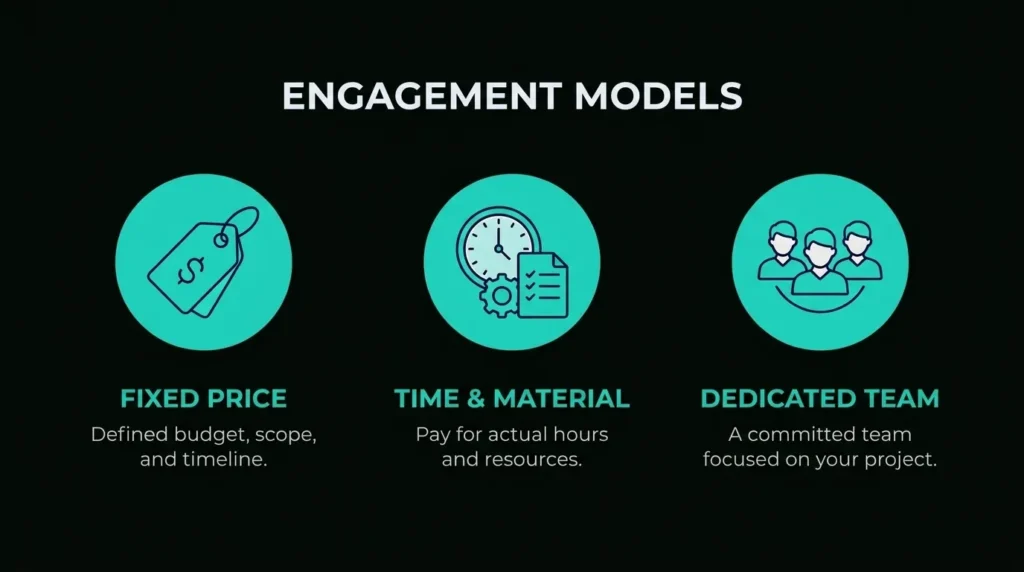
Fixed price. Best suited for well-defined projects with clear requirements, like a brochure website or an app with a locked feature list. Risk here is scope creep, since any change outside the original document typically triggers additional cost.
Time and material. You pay for actual hours worked, usually billed weekly or bi-weekly. This suits projects where requirements are expected to evolve, like a product still finding its market fit. Requires more trust and closer oversight from your side.
Dedicated team or staff augmentation. You pay a monthly rate for a developer, designer, or full team working exclusively on your project, often integrated into your existing processes and tools. This is common for longer term partnerships and startups scaling their engineering capacity without local hiring overhead.
A comparison table here showing typical hourly rate ranges, project suitability, and payment structure for each model would help readers scan this section quickly rather than reading dense paragraphs.
Rates vary widely depending on seniority and specialization, and we’d rather not throw out a number that becomes outdated or misleading without current market data to back it up.
What we tell prospective clients directly: if a quote seems dramatically lower than every comparable bid you’ve received, ask specifically what’s included, how many revision rounds are covered, what testing is performed, and what the post-launch support period looks like. The gap is rarely free.
Two Project Scenarios From the Field
Both scenarios below are hypothetical composites based on common patterns we’ve seen across projects, not details of a specific named client.
Scenario one: Replatforming an e-commerce store. A mid-sized retail client running an aging WooCommerce store was experiencing slow page loads during sale events and had outgrown the plugin-based workflow their previous developer had built. The project involved migrating product data, rebuilding the checkout flow with a custom backend, and integrating a regional payment gateway that WooCommerce didn’t natively support well.
The main challenge wasn’t technical, it was data migration without disrupting live sales. The approach that worked was running the new platform in parallel on a staging environment for several weeks, testing with real order data, and switching DNS only after a full checkout cycle had been verified end to end including refunds and inventory sync. Lesson from this kind of project: clients often underestimate how much time data migration and QA take compared to building new features, and a realistic timeline needs to account for that explicitly.
Scenario two: MVP for an early stage startup. A founder approached with a feature list that would have taken four to five months to build in full. Instead of building everything, the recommendation was to strip the scope down to the two features that would actually validate the core assumption of the business, launch in roughly six weeks, and use real user behavior to decide what to build next.
This is a common tension in early stage work: founders often want a complete product before they’re even sure the core idea resonates with users. The lesson here was that a smaller, faster launch gave the founder actual usage data to raise their next funding round with, instead of a feature-complete product nobody had tested yet.
How Websphere Hub Approaches Software Projects
We don’t claim to be the right fit for every project, and we’d rather say that upfront than oversell. What we can describe clearly is our process.
Discovery and scoping. Before any contract is signed, we spend time understanding the business problem, not just the feature list. A written scoping document comes out of this stage, which becomes the reference point for the rest of the project.
Design before development. Wireframes and prototypes go through a review cycle with the client before a single line of production code is written. This catches misunderstandings early, when they’re cheap to fix.
Sprint based development with visible progress. Work is broken into sprints with regular check-ins, so clients see progress incrementally instead of waiting weeks for a single big reveal.
Dedicated QA phase. Testing is handled separately from development, including functional testing, cross device checks, and performance testing before anything goes live.
Post-launch support window. A defined period after launch for bug fixes and stabilization, with clear terms on what’s included versus what counts as new scope .

Our team works across web development, mobile app development, UI and UX design, SEO, and digital marketing, which means a client doesn’t need to coordinate three separate vendors for a single product launch
A Practical Checklist Before You Sign
A short list worth running through before committing to any vendor, including us:
- Have you seen at least two to three portfolio projects genuinely comparable to yours in scope
- Has the vendor explained their team structure and who specifically will work on your project
- Is there a written contract covering IP ownership, payment milestones, and timeline
- Do they have a documented process for handling scope changes mid-project
- Have you spoken to at least one past client as a reference
- Is the pricing model fixed, time and material, or dedicated team clearly explained and matched to your project type
- Does the proposal include QA and post-launch support, or only initial development
If a vendor hesitates on more than one or two of these, that’s useful information before you commit budget and months of your timeline.
FAQs
What does a software house in Pakistan actually do?
It designs and builds digital products, typically websites, web applications, and mobile apps, for other businesses on a contract basis. Many also offer UI and UX design, SEO, and ongoing maintenance, so clients can get a full product lifecycle handled by one team instead of coordinating separate vendors for each service.
How much does it cost to hire a software house in Pakistan?
Costs vary widely based on project complexity, team seniority, and pricing model used. Fixed price works for well-defined projects, while dedicated team or time and material models suit evolving requirements. Getting quotes from two or three vendors for the same scope is the most reliable way to understand realistic pricing for your specific project.
How do I know if a software house in Pakistan is legitimate?
Check for SECP registration, ask for an NTN, and request references from past clients you can actually contact. Legitimate companies will readily provide a written contract covering IP ownership and payment terms before development starts, and won’t push back on reasonable due diligence questions.
Is it better to hire a software development company in Pakistan or a freelancer?
Freelancers suit small, well-defined tasks with lower budgets. A company is generally safer for larger projects needing multiple skill sets, long-term maintenance, or business continuity, since an agency can reassign work if one person becomes unavailable, while a freelancer typically cannot.
How long does it take to build custom software in Pakistan?
Timelines depend entirely on scope. A simple MVP might take six to eight weeks, while a complex platform with multiple integrations can take four to six months or longer. Any vendor promising a firm timeline before completing a proper scoping phase is likely underestimating complexity.
Which cities in Pakistan have the most software houses?
Lahore, Karachi, and Islamabad host the largest concentration of established software companies, though remote work has expanded capable teams into Rawalpindi, Faisalabad, and other smaller cities, which means physical location matters less than it used to for most remote engagements.
Conclusion
Choosing a software company in Pakistan comes down to matching your project’s complexity and risk tolerance to the right type of partner, then verifying that partner’s claims instead of taking a polished pitch at face value. Portfolio relevance, documented process, transparent pricing, and references matter more than a flashy website.
If you’re currently evaluating vendors for a web platform, mobile app, or a product that needs design and development handled by one accountable team, our web development services and mobile app development services pages outline how we scope and run projects at Websphere Hub, and we’re happy to walk through your specific requirements on an initial call before any commitment is made.